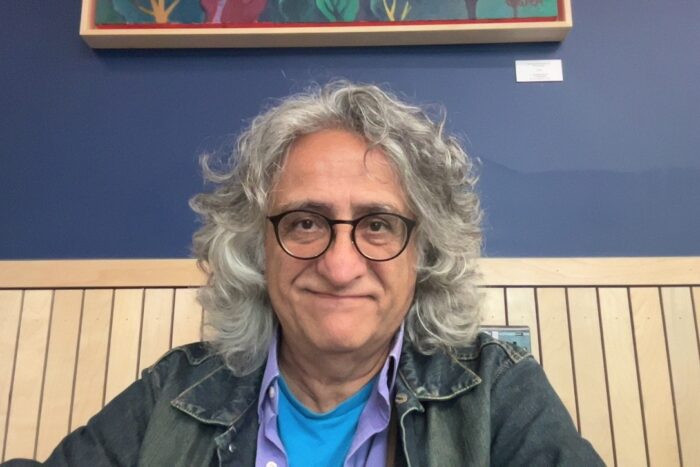
Farzad Mahootian is a Clinical Associate Professor of Global Liberal Studies at New York University. He has an interdisciplinary background (PhD Philosophy, Fordham; MS Chemistry, Georgetown). His research focuses on interactions between philosophy, science and society within the mythological imagination of technoscience and with guidance from process philosophy, biomimicry, artificial intelligence, and premodern sciences. His current collaborative research project is an AI-assisted study of multilingual alchemical texts, featured in a forthcoming special issue of Ambix, the Journal of the Society for the History of Alchemy and Chemistry. Other publications include, “Ideals of Human Perfection in Sufism and Transhumanism,” in Tirosh-Samuelson, H., et al., Building a Better Human (2012: Peter Lang); “Jung and Whitehead: An Interplay of Psychological and Philosophical Perspectives,” (with Tare-Marie Linné) in Held, B. & Osbeck, L., Rational Intuition (2014: Cambridge); “Paneth’s epistemology of chemical elements in light of Kant’s Opus postumum,” Foundations of Chemistry, (2013: Springer); “Kant, Cassirer, and the Idea of Chemical Element,” in Ghibaudi, et al, What is a Chemical Element? (2020: Oxford).
Farzad Mahootian
Faculty of Liberal Studies, New York University
Participant In These Roundtable Discussions
Sat
Apr 12th
2014
Apr 12th
2014
Watch
Synchronicity: On the Spectrum of Mind and Matter
“I have no doubt that the placing side by side of the points of view of a physicist and a psychologist will also prove to be a form of reflection.” —Wolfgang Pauli “Since physicists are the only people nowadays who would be able to deal with such a concept successfully, it is from a physicist... read more! »
Wed
Nov 5th
2014
Nov 5th
2014
Watch
Synchronicity and Other Mind Matter Conjectures
This program, co-sponsored by The Jungian Psychoanalytic Association and The Helix Center is free and open to the public. Pre-registration is required. For more information, consult the JPA website www.nyjung.org or contact Allison Tuzo at JPA@nyjung.org How are mind and matter related? In the mid-20th century, the psychiatrist and analyst Carl Gustav Jung and the... read more! »
Fri
Dec 1st
2017
Dec 1st
2017
Watch
Art and Science: The Two Cultures Converging
Man tries to make for himself in the fashion that suits him best a simplified and intelligible picture of the world; he then tries to some extent to substitute this cosmos of his for the world of experience, and thus to overcome it. This is what the painter, the poet, the speculative philosopher, and the... read more! »
Sat
Nov 19th
2022
Nov 19th
2022
Watch
Living in Difficult Times
Daily headlines have been startling and scary: “U.S. Life Expectancy Plunged in 2020, Especially for Black and Hispanic Americans,” reported The New York Times. “The Pandemic has Made Homelessness More Visible in Many American Cities,” noted The Economist, while The Guardian announced “The Latest UN Report is Clear: Climate Change is Here, It’s a Crisis, and It’s Caused by... read more! »
Sat
Mar 7th
2026
Mar 7th
2026
Attend
Stream
Where Have All the Isms Gone?: On the Evolution of Knowledge
Not very long ago the History of Ideas had been organized according to movements within each field. In Anthropology, for example, Malinowski was associated with Functionalism, Levi-Strauss with Structuralism, etc. Post-structuralism and postmodernism each in their turn at first appeared as “the next big thing.” These terms are familiar to many of us today and have been... read more! »