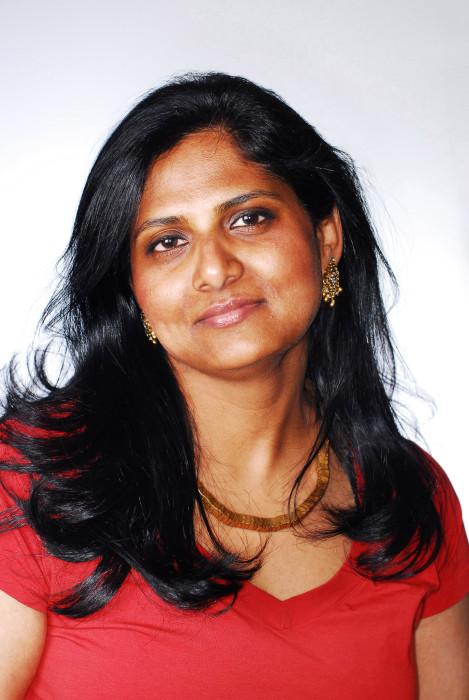
Priyamvada Natarajan’s research is focused on exotica in the Universe-dark matter, dark energy and black holes. She is noted for her key contributions to two of the most challenging problems in cosmology: mapping the distribution of dark matter and tracing the growth history of black holes. Her work using gravitational lensing has provided a deeper understanding of the granularity of dark matter in clusters of galaxies and offers a novel way to unravel the nature of dark matter. Natarajan also works on the assembly and accretion history of black holes. Deeply invested in the public dissemination of science, she serves on the Advisory Board of NOVA ScienceNow and is a fervent proponent of numerical literacy. Her first book, Mapping the Heavens: Radical Ideas That Reveal The Cosmos, published last year was received to great critical acclaim, winning an honorable mention from the Association of American Publishers, and as a finalist for the Top 10 Science Books by Physics World. She is also a published poet.
A professor in the Departments of Astronomy and Physics at Yale University, Priyamvada is also the Director of the Franke Program in Science and the Humanities. She is currently the Chair of the Division of Astrophysics of the American Physical Society. Recipient of many awards and honors in recognition of her contributions to science, she also holds the Sophie and Tycho Brahe Professorship at the Dark Center, Niels Bohr Institute in Copenhagen, Denmark and an Honorary Professorship at the University of Delhi, India.
Priyamvada has undergraduate degrees in Physics and Mathematics from MIT. She is also interested in the history and philosophy of science as well as technology and public policy and was enrolled in the MIT Program in Science, Technology & Society, where she was awarded a Master’s Degree (S.M.), and the MIT Program in Technology and Public Policy. She did her graduate work in theoretical astrophysics at the Institute of Astronomy, University of Cambridge in England, where she was a member of Trinity College and was elected to a Title A Research Fellowship. She was the first woman in Astrophysics to be elected a fellow of Trinity College, Cambridge.