Dr. Nikos A. Salingaros is Professor of Mathematics and Architecture at the University of Texas at San Antonio. An internationally recognized Architectural Theorist and Urbanist, his publications include the books Algorithmic Sustainable Design, Anti-Architecture and Deconstruction, A Theory of Architecture, Principles of Urban Structure, and Unified Architectural Theory, plus numerous scientific articles. He co-authored with Michael Mehaffy the books Design for a Living Planet, and A New Pattern Language for Growing Regions. Salingaros collaborated with the visionary architect Christopher Alexander over more than twenty years in editing Alexander’s monumental four-volume book The Nature of Order. Salingaros won the 2019 Stockholm Cultural Award for Architecture, and shared the 2018 Clem Labine Traditional Building Award with Michael Mehaffy. He has directed and advised twenty-five Masters and PhD theses in architecture and urbanism. Salingaros began working in the fine Arts as a painter, later becoming a scientist and polymath contributing to architectural theory, complexity theory, design philosophy, and urban theory. He holds a doctorate in Mathematical Physics from Stony Brook University, New York. Salingaros was visiting professor of Architecture at Delft University of Technology, Tecnológico de Monterrey, Querétaro, Mexico, and Università di Roma III. He published research on Algebras, Electromagnetic Fields, and Thermonuclear Fusion before turning to Architecture and Urbanism.
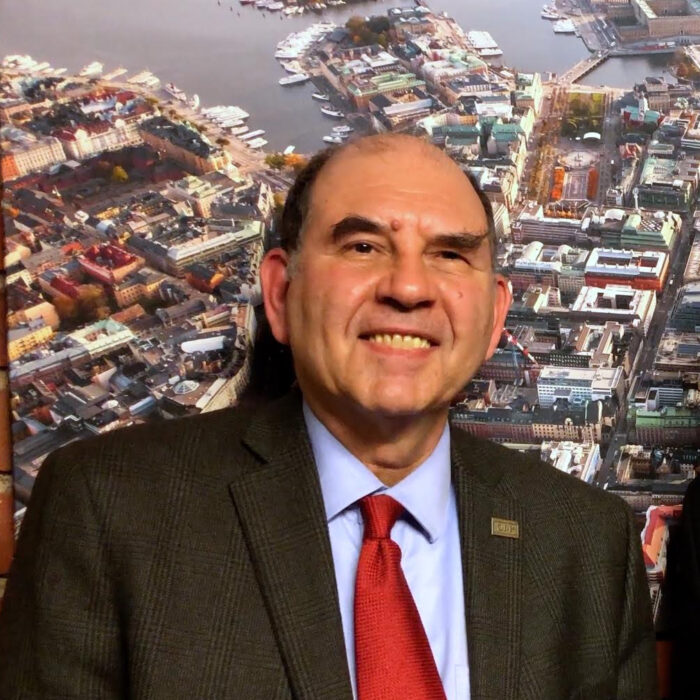
Nikos Salingaros
Professor, Mathematics & Architecture, University of Texas at San Antonio
Papers / Presentations
Architectural memes in a universe of information (Mondes Francophones, 2006)
Participant In These Roundtable Discussions
Sat
Oct 15th
2022
Oct 15th
2022
Watch
Coding and the New Human Phenotype
This conference explores the concept of life, knowledge, and experience through the lens of “code,” examining how meaning is encoded, transmitted, and transformed across biological, digital, and cultural systems. Through five roundtables, it investigates how we reconstruct the past, navigate authenticity in a digital world, interpret fiction and ideas, engage with AI-generated language, and consider the possibility that reality itself may be fundamentally computational—together asking what is gained, and what may be lost, as code increasingly mediates our understanding of the world.
Sat
Oct 15th
2022
Oct 15th
2022
Watch
Coding and the New Human Phenotype: Coding, Fiction, Metafiction – the Parcellation of What Isn’t There
This roundtable explores how fiction and ideas are encoded, transmitted, and transformed within culture. It considers the role of narratives, memes, and metafiction in shaping meaning and distinguishing fact from fiction.